Away from all the -ve noise, India is building

Discover India’s progress across technology, science, business, infrastructure, defence, sports, and society.

Latest News

Show more

Milestones

Show more
Science & Space
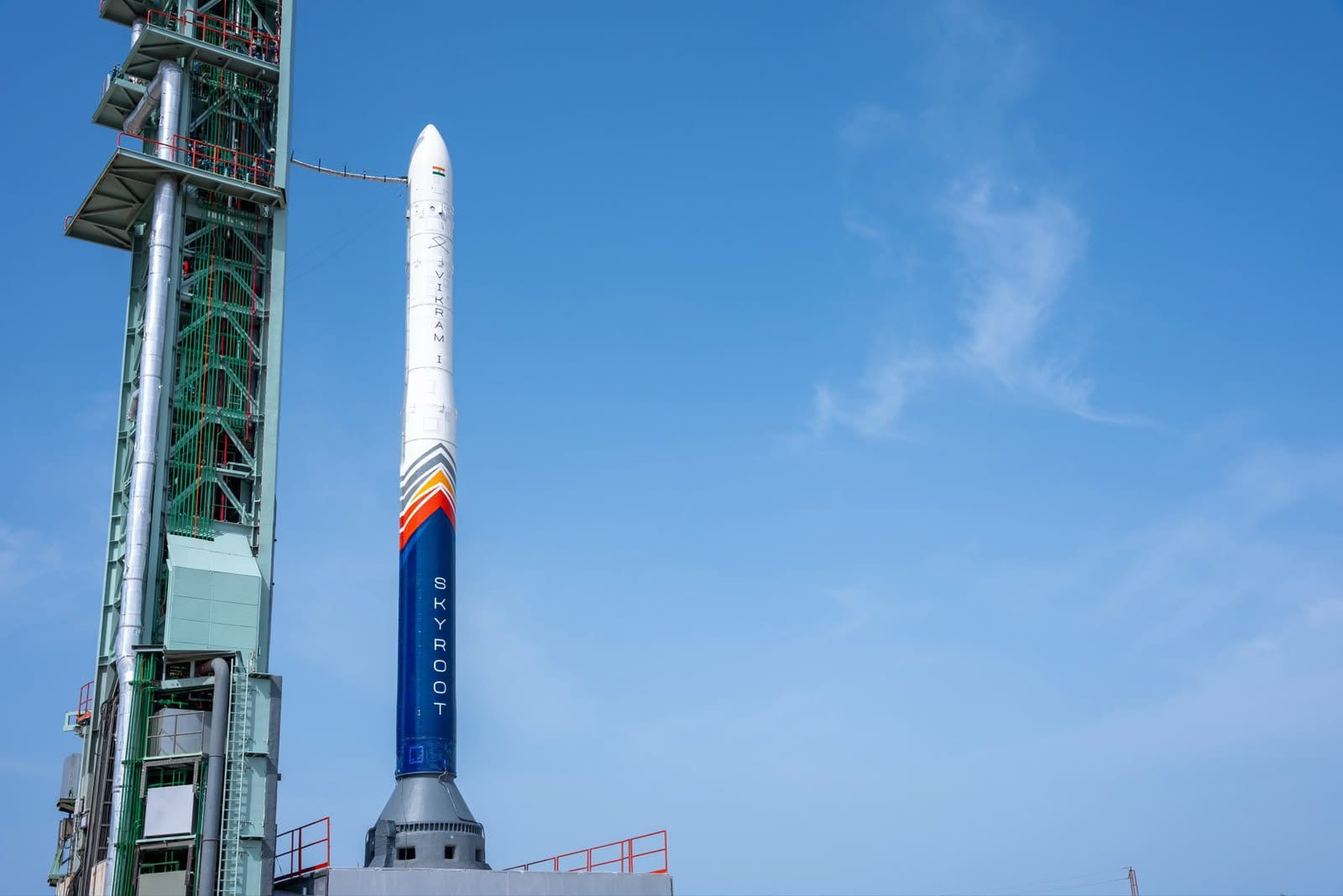
Skyroot Aerospace's First Orbital Launch
Private
18 July 2026
Skyroot Aerospace became the first Indian private company to successfully launch a rocket into orbit from Indian soil when its Vikram-I launch vehicle lifted off from the Satish Dhawan Space Centre in Sriharikota on 18 July 2026. The milestone marked a major transition in India's space programme from a predominantly government-led ecosystem toward one in which private Indian companies can independently develop and launch orbital-class rockets. Skyroot's journey began in Hyderabad in 2018 and progressed through privately developed rocket engines, the first private Indian rocket launch with Vikram-S in 2022, development and testing of Vikram-I, and the creation of a growing commercial space-launch company.
Infrastructure
India's First Hydrogen-Powered Train
Government
17 July 2026
India launched its first indigenous hydrogen fuel cell-powered passenger train on 17 July 2026 on the Jind–Sonipat section of Northern Railway in Haryana, joining a small group of countries worldwide developing or operating hydrogen-powered railways. Germany was the first country to introduce hydrogen passenger trains into commercial service, while countries including China, Japan, the United States, France and Italy have operated, tested or developed hydrogen rail systems. India's entry is particularly notable for the scale of its indigenous trainset: the 10-coach broad-gauge train has two 1,200 kW Driving Power Cars delivering a combined 2,400 kW, making it the world's longest and most powerful hydrogen trainset on a broad-gauge platform at the time of launch. Designed, engineered and integrated in India, the project also established an indigenous hydrogen rail ecosystem covering hydrogen production, storage, compression, dispensing and refuelling infrastructure at Jind.
Technology
Sarvam AI's Rise as India's Sovereign AI Company
Private
15 June 2026
Sarvam AI emerged as one of India's most significant artificial intelligence companies, building foundation models and a full-stack AI platform designed around India's languages, data and deployment requirements. Founded in 2023, the company progressed from Indian-language research and its Sarvam-1 model to government-backed sovereign AI development, increasingly capable open-source foundation models and large-scale commercial partnerships. In June 2026, Sarvam announced a $300 million Series B at a $1.5 billion post-money valuation, making it India's first major AI unicorn built around indigenous foundation-model technology.
Energy
Kalpakkam Prototype Fast Breeder Reactor
Government
6 April 2026
India's 500 MWe Prototype Fast Breeder Reactor (PFBR) at Kalpakkam, Tamil Nadu, achieved first criticality on 6 April 2026, marking a major milestone in India's indigenous nuclear programme and the transition toward the second stage of the country's three-stage nuclear power programme. The story traces back to Dr. Homi J. Bhabha, who formulated India's three-stage nuclear power programme in the 1950s around India's limited uranium resources and abundant thorium reserves. Decades of work by the Department of Atomic Energy, BARC, IGCAR and BHAVINI culminated in the indigenous design, construction and commissioning of the PFBR. The sodium-cooled fast breeder reactor is designed to generate 500 MWe while breeding additional fissile material from Uranium-238 and creating a pathway toward eventual utilisation of India's large thorium resources.
Defence
Operation Sindoor — India's Integrated Military Response
Government
7 May 2025
Operation Sindoor was launched by India on 7 May 2025 following the 22 April Pahalgam terrorist attack that killed 26 civilians. The operation began with precision strikes against nine sites that India identified as terrorist infrastructure belonging primarily to Jaish-e-Mohammed and Lashkar-e-Taiba in Pakistan and Pakistan-occupied Jammu and Kashmir. The confrontation subsequently expanded after Pakistani retaliatory drone and missile attacks, with India striking Pakistani air-defence systems and military airbases before military action stopped on 10 May. Beyond the immediate strikes, Operation Sindoor became an important demonstration of how India's military capabilities had evolved toward network-centric and multi-domain warfare. Indigenous systems including the Akash surface-to-air missile system, Akashteer air-defence command-and-control system, BrahMos cruise missile and Indian counter-UAS and electronic-warfare technologies were employed alongside other Indian and foreign-origin systems in a layered architecture. India's Integrated Air Command and Control System coordinated sensors, weapons and air-defence assets while drones and loitering munitions were used for surveillance and precision attack. The Government of India states that the initial strikes destroyed nine terrorist camps and killed more than 100 terrorists, while subsequent operations inflicted significant damage on Pakistani military infrastructure including multiple airbases. Some battle-damage and aircraft-loss claims remain disputed between India and Pakistan, although independent reporting and satellite imagery confirmed damage at several Pakistani military facilities. The operation therefore represented both a combat test of India's expanding indigenous defence-industrial capabilities and a demonstration of increasingly integrated Army, Air Force and Navy operations.
Science & Space
SpaDeX — India Becomes Fourth Nation to Achieve Space Docking
Public Institute
16 January 2025
India became the fourth country in the world to successfully demonstrate space docking technology when ISRO's Space Docking Experiment (SpaDeX) spacecraft SDX-01 and SDX-02 docked in orbit on 16 January 2025. India joined an elite group consisting of the United States, Russia and China with the capability to rendezvous and dock spacecraft in space. The indigenous technology is strategically important for India's future space ambitions because docking is required for missions involving multiple spacecraft launches, orbital assembly, satellite servicing, Chandrayaan-4's lunar sample-return architecture and the planned Bharatiya Antariksh Station. ISRO subsequently demonstrated successful undocking in March 2025, followed by a second fully autonomous docking and bidirectional power transfer between the two spacecraft in April 2025.
Science & Space
Agnikul Cosmos' Agnibaan SOrTeD Launch
Private
30 May 2024
Agnikul Cosmos became the second Indian private company to launch a privately developed rocket when its Agnibaan SOrTeD mission successfully lifted off from India's first private launchpad at Satish Dhawan Space Centre, Sriharikota, on 30 May 2024. The mission demonstrated a semi-cryogenic rocket engine using additive manufacturing and marked a major milestone in India's emerging private space industry. Agnikul's journey began in 2017 and progressed through the development of its single-piece 3D-printed Agnilet engine, collaboration with ISRO, creation of a private launchpad and rocket factory, multiple engine tests, and eventually the successful controlled flight of Agnibaan SOrTeD.
Science & Space
Aditya-L1 — India's First Solar Observatory
Government
6 January 2024
India's first dedicated space-based solar observatory, Aditya-L1, successfully entered a halo orbit around the Sun–Earth L1 Lagrange point on 6 January 2024, approximately 1.5 million kilometres from Earth. From this unique location, Aditya-L1 can continuously observe the Sun without the regular eclipses or occultations experienced by Earth-orbiting spacecraft. Carrying seven indigenously developed scientific payloads, the mission studies the Sun's photosphere, chromosphere, corona, solar wind, energetic particles and magnetic environment, helping scientists better understand solar eruptions and space weather that can affect satellites, communications, navigation systems and power infrastructure on Earth. Since reaching L1, Aditya-L1 has produced significant scientific observations, including unprecedented near-ultraviolet observations of solar flare activity, while its scientific datasets have been made available to researchers in India and around the world.
Science & Space
Chandrayaan-3
Government
23 August 2023
Chandrayaan-3 was India's third lunar exploration mission and successfully demonstrated India's capability to achieve a controlled soft landing and rover operations on the Moon. Launched by ISRO in July 2023, the mission's Vikram lander successfully landed near the lunar south polar region on 23 August 2023, making India the first country to land a spacecraft in the region and the fourth country to achieve a soft landing on the Moon.
Technology
5G Rollout in India
Government
1 October 2022
India launched 5G mobile services on 1 October 2022, beginning one of the world's fastest large-scale deployments of next-generation mobile infrastructure. Following the government's 2022 spectrum auction and telecom-sector reforms, private telecom operators rapidly deployed hundreds of thousands of 5G base stations across the country. Within roughly two years, 5G had reached nearly every district in India. By February 2026, 5G services were available in 99.9% of districts with 5.23 lakh 5G Base Transceiver Stations installed nationwide, creating infrastructure for high-speed connectivity, fixed wireless access, smart manufacturing, healthcare, agriculture and other digital applications.